
The Alleged Marriage of Robert Dudley and Douglas Howard - 1573
thedudleywomen
May 14
14 min read
Updated: Aug 5

On 10 February 1604, Lettice Knollys, Dowager Countess of Leicester, filed a bill in the Court of the Star Chamber against Sir Robert Dudley, the illegitimate but acknowledged son of her second husband Robert Dudley, 1st Earl of Leicester. Dudley, also known as "Robin Sheffield", had disputed that he was not of illegitimate birth, but rather that he was born from a legal union between his parents - Leicester and his one time paramour Douglas Howard, Lady Sheffield - which had taken place over three decades earlier, and argued that he should therefore be acknowledged as his father's lawful heir. Testimony was subsequently obtained from his mother in support of his claim, providing details regarding her relationship with Leicester, including of their alleged union, which was said to have taken place in 1573.
Douglas Howard was the eldest daughter of courtier and diplomat William Howard, 1st Baron Howard of Effingham. Like many of her contemporaries, the teenage Douglas had joined the new household of Elizabeth I in January 1559, initially as an unmarried Maid of Honour, shortly after the queen's accession to the throne. In October 1560, Douglas left court, following her marriage to her first husband John Sheffield, 2nd Baron Sheffield; however, her husband died prematurely of 'poor health' in December 1568, aged only 30 years old, leading the newly-widowed Lady Sheffield to return to court, as an honorary Gentlewoman of the Privy Chamber (Whitelock, 2013; Folgerpedia [1], 2025).

Leicester had been a long-time favourite of Elizabeth, following her accession to the throne in November 1558, when he was appointed to the prestigious position of Master of Horse. This appointment to her household led to the couple spending an increasing amount of time together, leading to Dudley's increased estrangement from his first wife, Amy Robsart, whom he had married in a love-match, in 1550. Amy had died in suspicious circumstances in September 1560, having been found with a broken neck, at the bottom of a flight of stairs. Whilst suspicion initially fell on Dudley, given his known closeness with Elizabeth, a Coroner's Inquest later ruled that Amy's death was not as a the result of murder or suicide, and that "misfortune came to her death and not otherwise". Despite the scandal that surrounded him after Amy's death, Dudley soon found himself back in the queen's favour, much to the chagrin of his political rivals (Wilson, 1981; Gristwood, 2009; The National Archives [1], 2024).
[See THE DUDLEY WOMEN post: The Death of Amy Robsart - 08 September 1560]
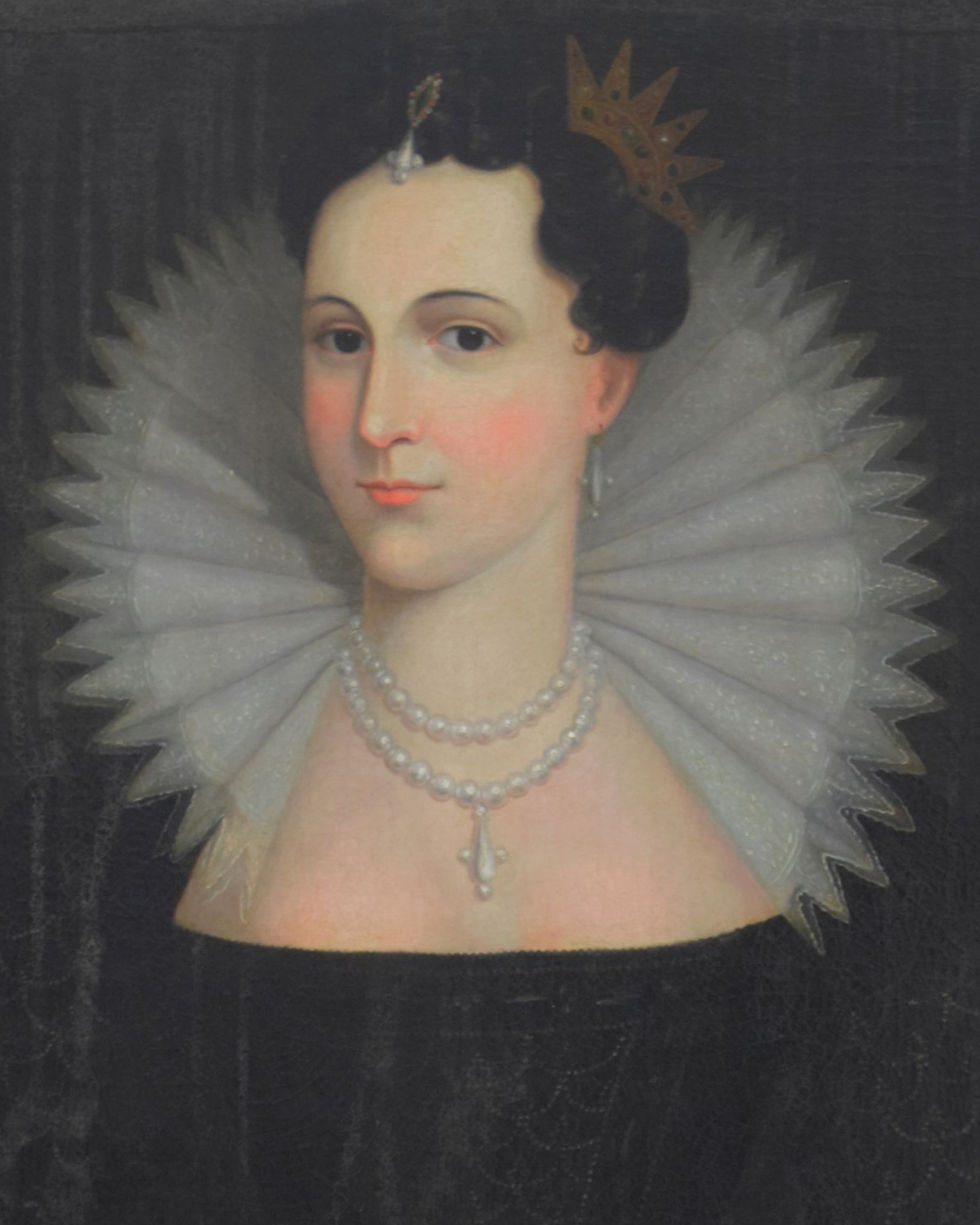
The precise beginning of Douglas's affair with Leicester is unconfirmed, although it was said that it was shortly after her return to court in 1569. On 11 May 1573, Gilbert Talbot, son and heir of George Talbot, 6th Earl of Shrewsbury, wrote to his father from Greenwich, updating him on court news; Talbot confirmed that whilst Leicester continued to be close to the queen, being "very much with her Majesty", and that she in turn showed him "great affection", that "there are two sisters now in the court that are very far in love with him, as they have been long, my Lady Sheffield and Frances Howard; they of like striving who shall love him better are at great wars together, and the Queen thinketh not well of them, and not the better of him". The highly-flirtatious Leicester had remained popular with the ladies of the court throughout his close relationship with the queen, and whilst not promiscuous, it was believed that he had secretly engaged in sexual relationships with other women, whilst openly declaring his allegiance, loyalty and fidelity to Elizabeth (Wilson, 1981; Whitelock, 2013; Folgerpedia [1], 2026).

Prior to Leicester and Douglas embarking on their affair, Leicester had made it known to his lover that despite their shared widowhood, he had no intention of entering into an engagement or marriage with her, for fear of losing the queen's favour. An undated letter written by Leicester, most likely to Douglas before 1574, addressed to "my dear friend...long both loved and liked you", reiterated to its recipient his long-held intentions which "hath not changed from that it was at ye beginning toward you", with the Earl confirming that "I did plainly and truly open unto you in what sort my good will should and might alway remain to you". In this letter, Leicester reflects that over the course of their affair, Douglas's expectations from their relationship had evolved, and in him remaining resolute, had subsequently caused "unkindness", "great mislike and grief" and "strangeness" over the previous six months. Leicester writes of "my brother you see long married and not like to have children", reflecting on the third marriage of his elder brother Ambrose Dudley, 3rd Earl of Warwick to Anne Russell in 1565, that whilst successful, did not produce any children. He acknowledges that "being now ye last of our house", the responsibility of "leaving some children behind me" now fell to him, and he was disinclined to do this without first taking a wife, which he had again reinforced would not be Douglas - "that ye same I was at ye beginning the same I am still toward you, and to no other or further end can it be looked for". Leicester's intentions, having been made clear once again, did not fully dissuade Douglas, and their affair continued (Hartweg, 2013; Paul, 2022).

Some historians believe that despite Leicester's strong protestations in his letter, as well as his encouragement for Douglas to seek another husband if not content with the arrangements set out, the Earl later conceded and agreed to marry his lover. Douglas later alleged that she had formally been contracted to marry Leicester in 1571, at a property on Cannon Row, Westminster, and that the couple later married in a clandestine ceremony, in her chambers at Esher Palace, Surrey. Different dates have been suggested for the marriage: May 1573, when the court were more than twenty-miles north-east at Greenwich, and "Winter" 1573, when the court were based at Whitehall. The manor of Esher had previously been leased to Douglas's father by Elizabeth I, and on his death, had passed to her brother Charles Howard, 2nd Baron Howard of Effingham, despite remaining in the possession of the Bishops of Winchester (Wilson, 1981; Hickey, 2021; Folgerpedia, [1], 2026; Tudor Place, 2026). Douglas reported that only a handful of witnesses were present, that she was 'given away' by Edward Horsey, one of 'Leicester's men', and that during the ceremony the Earl presented her with a diamond ring, which he had reportedly obtained from Henry Herbert, 2nd Earl of Pembroke, "on the condition that he would give it to no one other than the woman he married" (Hickey, 2021, p.45).
Following this alleged ceremony, in the privacy of Esher and the newly-constructed Leicester House, which also provided comfortable and convenient accommodation for Ambrose Dudley, when the latter was attending court, Douglas was said to have 'behaved' as the Countess of Leicester. However, publicly the couple continued to live separate lives, Leicester continuing to display his allegiance to Elizabeth (Weir, 1999; Hickey, 2021).
[See THE DUDLEY WOMEN Post: Leicester House, The Strand, Westminster]

Despite Leicester's previously-held belief that "there is no likelihood that any of our bodies of mankind like to have heirs", by spring 1574, it became evident that Douglas was carrying her lover's child. With the court continuing on the annual summer progress, the heavily-pregnant Douglas remained behind at Richmond Palace, for her lying-in; on 07 August 1574, she gave birth to a son, her third child, whom she named for his father. Leicester, who was accompanying the queen on her progress, was informed of his son's birth by a letter, following which he shared the happy news with family and friends. The Earl was said to have written back to Douglas, congratulating her on their son's birth, in which he ended it "Your loving husband" (Hartweg, 2013; Hickey, 2021).
Leicester always acknowledged paternity of Robin, although maintained his illegitimacy, referring to him as "my base son" and "the badge of my sin" (Wilson, 1981, p.208). Regardless, Leicester took an active role in his son's upbringing, placing the child into the custody of his cousin, John Dudley at Stoke Newington, and overseeing his education, with Robin entering Christ Church, Oxford in May 1588, aged 14 (Whitelock, 2013; Tallis, 2017).

Lettice Knollys, Countess of Essex, was one of the queen's close relations, being the daughter of Elizabeth's maternal cousin Catherine Carey, Lady Knollys, as well as a former member of the royal household, being appointed as a Gentlewoman of the Privy Chamber on her kinswoman accession to the throne. Like Douglas, Lettice had left her position at court in the New Year 1560, following her own marriage to Walter Devereux, 1st Earl of Essex. Whilst rumours of a 'flirtation' between Lettice and Leicester dated back to 1565, the couple appear to have embarked on an affair around 1574; Essex had been posted to Ireland, exacerbating a pre-existing estrangement between the married couple. On Essex's return to England in late 1575, there were reports of animosity between the two noblemen, as well as unsubstantiated rumours that Leicester had fathered two children with Lettice (Tallis, 2017; Folgerpedia [1], 2025).
In her later testimony, Douglas alleged that her relationship with Leicester finally came to an end in the summer of 1576, his contact with her having been sporadic since the birth of their son. Coinciding with Essex's final assignment to Ireland in July 1576, Douglas alleged that she secretly met with Leicester in the gardens of Greenwich Palace, where the royal court was in residence. Douglas reported that Leicester, in the presence of two witnesses, informed her that their relationship was finally over. She alleged that the Earl offered her £700 if she agreed to "disavow marriage" and relequenish custody of her son to him. Douglas reported that she refused this offer, which angered the Earl, him expressing his belief that their union had never been legal (Gristwood, 2009; Folgerpedia [2], 2026)

Following Essex's death in Ireland from dysentery in September 1576, the clandestine relationship between Leicester and Lettice continued. It was later alleged that the couple exchanged wedding vows in a secret ceremony in Spring 1578 at Kenilworth. However, as there were no known witnesses to this first service, Lettice's father Sir Francis Knollys, Treasurer of the Royal Household, insisted on another ceremony being held, in the presence of witnesses, including himself. It has been speculated that Knollys, whilst a close friend and ally of Leicester's, had heard the gossip relating to his previous union with Douglas, and so wanted to ensure a legally recognised union took place, in order to protect his daughter's reputation, and ensure that she could not be so easily thrown aside, as her predecessor had been (Wilson, 1981; Folgerpedia, 2025).
[See THE DUDLEY WOMEN Post: The Marriage of Lettice Knollys and Robert Dudley - 21 September 1578]

Following the birth of her son, and the end of her relationship with Leicester, Douglas is known to have returned to court. She is known to have presented a New Year's Gift to the queen in 1576, and was one of twenty-seven ladies of the court present at New Year 1577, listed by poet George Gascoigne in his work, The Grief of Joy (Folgerpedia [1], 2025). On 28 November 1579, Douglas legally remarried in her own clandestine ceremony, held at her Blackfriars home, to diplomat Edward Stafford. In January 1580, Stafford was dispatched as a 'Special Ambassador' to France; on his return to England the following month, Elizabeth learned of his union with Douglas. An inquiry was subsequently launched, with the intent of confirming the validity of the marriage; Stafford himself was summoned for a 'dramatic interview' with the queen, during which he argued against any claims of invalidity or bigamy. Whilst rumours of a previous union between Douglas and Leicester had spread amongst the court, which had earlier been dismissed, it was felt that the likely motivation behind this investigation was the queen's indirect challenging of Leicester's marriage to Lettice. Elizabeth had viewed the latter union as a great act of betrayal from both parties, and had subsequently banished her kinswoman from court, never to forgive her; with this investigation, lay the queen's hopes of revenge and subsequent humiliation for her rival; however, the investigations concluded that both marriages were lawful and valid (Weir, 1999; Gristwood, 2007; Oxford Authorship Site, 2025; Folgerpedia [2], 2025).

An inventory taken in 1580, documenting the contents of Leicester House, the Earl's palatial town house located on The Strand, Westminster, interestingly includes a portrait miniature of Douglas: "The picture of my La. Sheffield enclosed in a wainscot case" (Owen, 1980. p.203). Douglas however was not the only member of the Howard family immortalised in art within the walls of Leicester's home, with the Earl known to commission and possess many pieces of art portraying beloved friends and family members. Further inventories taken in 1584 and (posthumously) in 1590 note portraits of 'My Lord Admirale', this being Douglas's older brother Charles Howard, 2nd Baron Howard of Effingham, who held the coveted position of Lord High Admiral, and whom Leicester nominated as one of the executors of his will (Owen, 1980; The National Archives [2], 2024).
In 1584, Leicester's Commonwealth (or The Copie of a Leter wryten by a Master of Arts of Cambrige), a piece of Catholic propaganda written objecting Elizabeth I's religious and political policies, was published. This book set out personal attacks scandals and accusations against Leicester, including that he had played an active role in multiple deaths of those close to him, including Amy Robsart, and the husbands of Douglas and Lettice. Referred to in the pamphlet as "The suspicious death of Lord Sheffield", the author highlights the "convenience" and "fortune" regarding the death of John Sheffield (Oxford Authorship Site, 2026):
"...he fell in love with Lady Sheffield...and then also he had the same fortune to have her husband dye quickly, with an extreame rhueme in his head (as it was given out) but as others say, of an artificial catarre that flopped his breath".

The pamphlet also alleged that in addition to son Robin, Douglas and Leicester had another child "a daughter, born (as is known) at Dudley Castle". However, the book presents a counter-argument in response to these rumours, in that Douglas purposely travelled to Dudley Castle, away from the prying eyes and gossip of court, where she "feign[ed] herself to be with child", shortly after which she "delivered of a cushion". It is alleged that whilst "scared ceremonies" were conducted at Dudley, including those of an internment of a coffin "buried with a bundle of clouts in show of a child". In her 1604 deposition, Douglas refuted these claims, asserting that Robin was the only child born from her relationship with Leicester (Hickey, 2021; Oxford Authorship Site, 2026).
Leicester died in September 1588; his detailed will which had been written the previous year in August 1587, set out his requests for his burial as well as making arrangements and bequests regarding his multiple properties. Having no survivng legitimate children, Leicester nominated his brother Ambrose as his "right and lawfull Heir", and primary beneficiary. He continued to acknowledge "my Base son Robert", bequeathing him lands and estates, as well as making provisions for further inheritance following the deaths of Ambrose and Lettice, including his beloved Kenilworth (Wilson, 1981; The National Archives, 2024).

Shortly after the death of Elizabeth I in March 1603, and subsequent accession of James I, Robin made public declarations related to his birth, alleging that he had been born from a lawful marriage, being described by Warner (1899, p.xxxviii) as being of a "proud and sensitive nature", who would "seize any opportunity to remove the stigma of his birth". Legal acceptance of these claims would ensure Robin's acknowledgement as Leicester's lawful heir, and allow him claim to legitimately claim the lands and titles from his Dudley family, including the Earldoms of Leicester and Warwick. Lettice quickly responded to her stepson's allegations, as if found to be true, would have rendered her own marriage to Leicester invalid and bigamous. In February 1604, the Dowager Countess of Leicester subsequently filed a bill against Robin in the Court of the Star Chamber - a court comprised of judges and privy councillors, held at the Palace of Westminster (Tallis, 2017).
The court hearing, referred to as Robin's 'great cause', lasted fifteen months, during which time multiple pieces of evidence were produced and witnesses called from both parties; fifty-six witnesses were called in support of Lettice, reasserting her claim that Leicester had never considered Robin as his legitimate son and heir. Robin in turn made allegations that Lettice had purposely removed key pieces of evidence from Kenilworth, which he believed would have supported him in his pursuit. Douglas reluctantly agreed to support her son; in written testimony, delivered to the court in June 1604, she set out her claims of both a marriage contract and secret ceremony in 1573. However, Douglas was unable to provide details of the exact date of the union, nor could she recall the name of the minister who reportedly solemnised their marriage. The reported witnesses to the union were all since dead, with Douglas alleging that her request for more witnesses to be present had been refused by Leicester, for fear that news of it would get back to the queen. Douglas also denied speculation that Leicester was responsible for arranging her subsequent marriage to Edward Stafford, the latter also testifying to this (Tallis, 2017; Hickey, 2021; Oxford Authorship Site, 2025; Folgerpedia, [1], 2026).


Comments