
The Birth of "Robin Sheffield" - 07 August 1574
thedudleywomen
Aug 7
11 min read
Updated: Sep 4

On 07 August 1574, whilst Elizabeth I and her Royal Court were in the midst of the queen's annual summer progress, one of the Ladies of the Royal Household, Douglas Howard, Lady Sheffield, who had remained behind, gave birth to a baby boy at Sheen House, located within the grounds of Richmond Palace, Surrey.
In the first half of her reign, Elizabeth I had continued her father Henry VIII's tradition of an annual summer progress; leaving London and her royal palaces behind her, the queen travelled to towns, cities, manors and estates within Southern England and the Midlands during the warm summer months. Elizabeth's yearly excursions, described by Nichols (1823, p.xi) as a "plan of popularity", allowed her subjects in these counties to catch a glimpse at their monarch and her accompanying procession, as well as providing an advantageous, albeit expensive, opportunity for the favoured members of the court and aristocracy to play host to the queen and her companions (Lyon, 2016; Folgerpedia [1], 2026).

Accompanied by members of her household and royal court, including her long-time 'favourite' and Master of Horse, Robert Dudley, 1st Earl of Leicester, Elizabeth left Windsor Castle, arriving on 15 July 1574 at Reading Abbey, where that year's progress began; the journey that summer took the court through the southern counties of Berkshire, Oxfordshire, Gloucestershire, Bristol, Somerset, Wiltshire, Hampshire and Surrey. Elizabeth was said to have been 'melancholic' since the spring, due to matters of state, including the ongoing imprisonment of Mary, Queen of Scots, as well as apprehensive in leaving the capital behind, for fear of action being taken in her absence. She therefore instructed some of her loyal counsellors to remain behind, rather than accompany her on her progress as they had previously done; these included William Cecil, 1st Baron Burghley, Lord High Treasurer and Sir Francis Walsingham, Secretary of State. The procession would have been a great sight: the queen and her attendants would be accompanied by a baggage train, made up of in excess of 300 carts, each pulled by several horses, carrying the essentials of clothing, linen and cooking utensils required for an extended journey (Nichols, 1823; Gristwood, 2007; Folgerpedia [1], 2026).
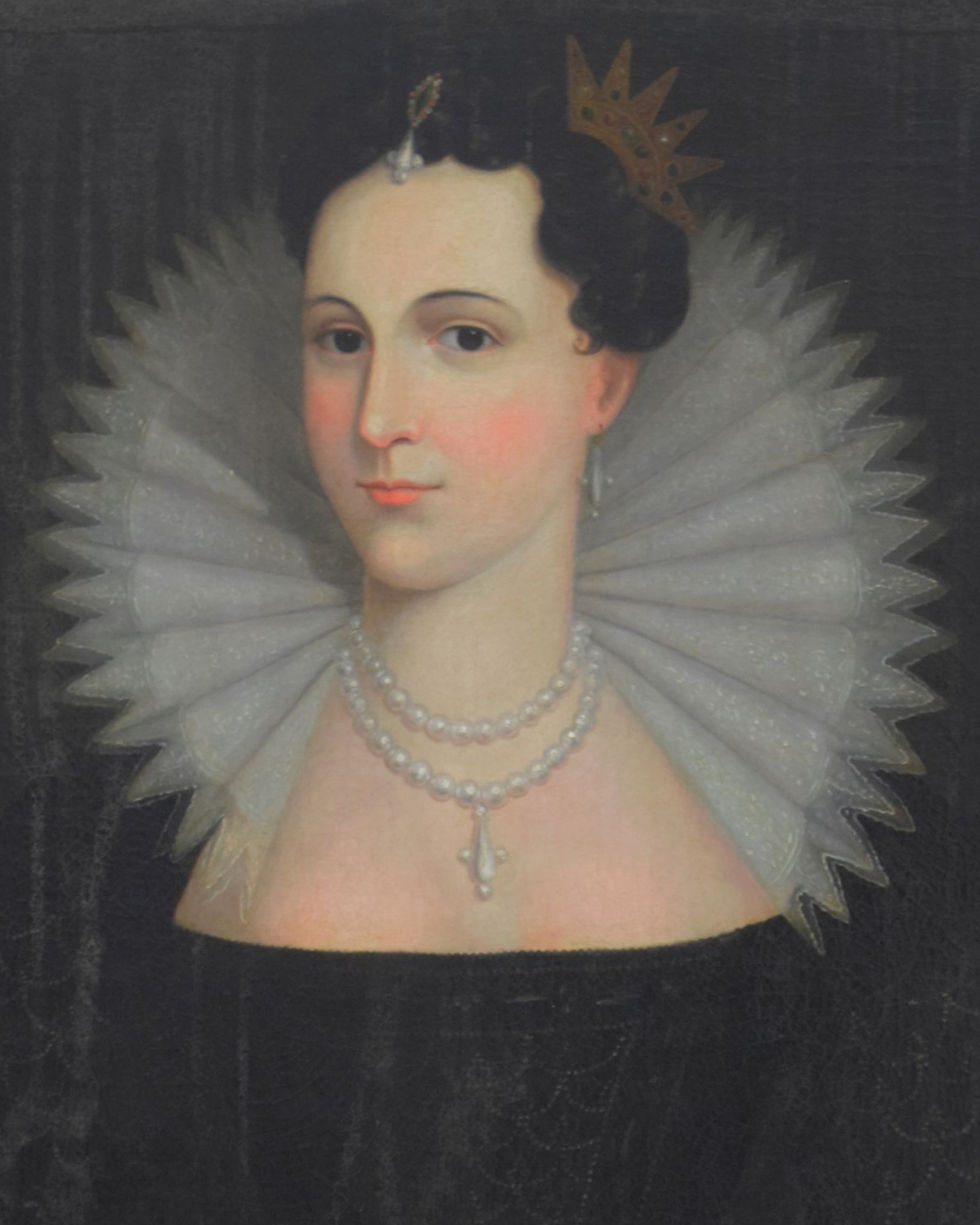
One of the ladies of Elizabeth's household who also did not accompany the queen that summer was the heavily-pregnant Douglas Howard, Lady Sheffield. A teenage Douglas had initially joined the Royal Household, as an unmarried Maid of Honour, in January 1559, shortly after the Elizabeth's accession to the throne. Having retired from her post less than two years later, following her marriage to John Sheffield, 2nd Lord Sheffield, Douglas subsequently returned to court in 1569, following her husband's death, adopting the position in the queen's household as an honorary Gentlewoman of the Privy Chamber. It is believed that shortly after her return, the young widow embarked on an affair with Leicester, who had also remained widowed following the sudden death of his wife Amy Robsart in September 1560 (Whitelock, 2013; Folgerpedia, 2025).
The exact beginning of the couple's relationship remains unconfirmed; however in May 1573, Gilbert Talbot, son and heir of George Talbot, 6th Earl of Shrewsbury wrote to his father, updating him on news from the court, reporting that "there are two sisters now in the court that are very far in love with [Leicester]...my Lady Sheffield and Frances Howard". Whilst Leicester had remained loyal and close to the queen during her reign, being "very much with her Majesty", it was believed that he simultaneously engaged in discreet sexual relationships with other women, including favoured women in the queen's own household. However, in contrast to the relationship that he later formed with her younger kinswoman Lettice Knollys, Countess of Essex, Elizabeth was said to have tolerated these affairs, including that with Douglas, not perceiving them as a threat to her longstanding intimate relationship with her 'favourite' (Wilson, 1981; Whitelock, 2013; Hickey, 2021).

An undated letter sent by Leicester, most likely to Douglas before 1574, sets out his intentions and expectations of their ongoing affair; whilst he acknowledges that he had "long both loved and liked you", Leicester dismissed any intent to enter into matrimony. He reflected on the 1565 marriage of his only surviving brother Ambrose Dudley, 3rd Earl of Warwick to Anne Russell, that whilst loving, supportive and successful, had not produced any children. He recognises that "being now ye last of our house" the responsibility of "leaving some children behind me" now fell onto him. However, Leicester asserts that he was reluctant to do this without first taking a wife, and in this letter, repeatedly reaffirmed that he would not be making any offers of marriage.. Despite Leicester's intentions being made clear, including his assertions that "there is no likelihood that any of our bodies of mankind like to have heirs", by spring 1574, it became evident that Douglas was carrying her lover's child (Gristwood, 2007; Hartweg, 2013).

When the queen and court moved from Richmond Palace to Windsor in early July, in preparation for the start of the summer progress, Douglas remained behind, having likely began preparations for her 'lying-in'. It was unusual for noble women during the Tudor period to give birth at court, most returning to their family country homes; however, Douglas's unmarried status may be the reason for her choosing nearby 'Sheen House' as the location for her to enter her confinement. The former Carthusian monastery based at the Charterhouse at Sheen, located within the royal manor of Richmond and sometimes documented as 'Cien', had been dissolved in 1539, as part of the systematic process known as the Dissolution of the Monasteries. The property had initially been granted to Edward Seymour, then Earl of Hertford, and later to Henry Grey, 1st Duke of Suffolk, father of Lady Jane Grey. Following Suffolk's conviction for treason, the property returned to the Crown, although his widow Frances Brandon, Duchess of Suffolk, was permitted by her paternal cousins, Mary I and Elizabeth I, to continue residing there until her death in 1559. In 1574, Sheen continued to be the property of the Crown, and the location chosen by Douglas to spend her last month of pregnancy (British History Online, 2024; McElroy, 2024).

Douglas is likely to have entered into her 'confinement' only days after Elizabeth and the court left Richmond Palace on 05 July 1574, it being tradition for this to take place in the last four weeks of a woman's pregnancy. The rooms chosen for her 'lying-in' and subsequent delivery would have been prepared prior to her admission: the majority of windows closed and kept shut throughout, with tapestries and cloths hung on the walls, and fires lit, creating a warm, comforting and intimate environment. Once the expectant mother entered the room, she would not leave until after the birth; all meals and visitations from other women would take place in these allocated rooms, being attended to by a select trusted women (McElroy, 2024; Folgerpedia [1], 2026).
The knowledge and expertise of childbirth in Tudor England fell to women; the role of a midwife was a highly sought-after and influential profession, the younger women having learned their trade from shadowing more experienced ones, and the responsibility of mother and baby during childbirth fell to these, rather than male surgeons. Some midwives had been licensed by the Church authorities, in the tragic event that they would need to perform emergency baptisms on those babies at risk of death. In 1540, The Birth of Mankind, written by German physician Eucharius Rösslin, had been translated into English and subsequently published, becoming a successful guide through pregnancy, childbirth process and the care of a newborn. Among the advice given, Rösslin made recommendations for the labour process: the ideal temperature of the room, the position the woman should take during labour, and what steps a midwife should take if difficulties were to arise during delivery (Norton, 2017; Orme, 2023). McElroy (2024) also acknowledges that women, especially if delivering their first child, often looked to the knowledge and experience of older female relatives, including their own mothers, including returning back to their childhood home for the birth, a practice that continued into the 20th century.

Douglas gave birth to her baby son, her third living child, on 07 August 1574, reportedly in a room referred to as the 'Duke's Chamber' at Sheen House; the date of his birth was later confirmed in documentation presented as evidence to the Star Chamber in 1604 (Warner, 1899). Immediately after birth, the newborn's umbilical cord would have been cut by the midwife, his body then wrapped in a piece of flannel or linen, and washed. An absorbent breechcloth would have then been fastened and pinned to his body, following which the baby would have been 'swaddled' - his body wrapped in long, narrow pieces of linen, his limbs tied tight and straight. A wet nurse is likely to have been employed, as was common with aristocratic families; wet nurses would often remain with the baby until they were weaned, between one and two years old (Norton, 2017; Orme, 2023; McElroy, 2024).

The queen and court had arrived in the Gloucester on 06 August 1574, the day before Robin's birth; Elizabeth was reported to have stayed at the home of Richard Pate, Member of Parliament and Recorder for Gloucester, located on Westgate Street, near to St Nicholas's Church. The party remained in the city until 10 August, following which the journey continued through Gloucestershire, thereafter arriving in Bristol on 14 August (Folgerpedia [1], 2026). Leicester was reportedly in Bristol when word of the birth of his son reached him, the news being sent from Richmond by William Clewer, a member of Douglas's household. It was said that the earl did not keep his first child a secret from his close family and friends, celebrating his birth; however, whilst always acknowledging his son's paternity, Leicester also considered him illegitimate, referring to him as "my base son" and "the badge of the my sin" (Wilson, 1981, p.208; Gristwood, 2007; Hickey, 2021).

After delivering the news to Leicester, Clewer made the long journey back to Richmond for the baby's baptism; he reportedly carried with him a letter from Leicester to Douglas, in which he thanked his paramour for the safe delivery of their child, signing his reply "Your Loving Husband". The boy was named after his father - Robert Dudley - although came to be known as "Robin Sheffield" during his lifetime. On his return to Surrey, Clewer acted as a proxy at the ceremony on behalf of one the boy's godfathers Sir Henry Lee. Robin's other sponsors, paternal uncle Ambrose Dudley, 3rd Earl of Warwick and Anne Fiennes, Lady Dacre of the South were also represented by proxies; Lady Dacre was represented by Mrs Avice Erisa, who was present throughout Douglas's lying-in, whilst Warwick was nominated by "Dr Julio" - Giulio Borgherini, Leicester's Italian physician, who was later alleged to have been present during his parents's marriage ceremony (Warner, 1899; Hickey, 2021). A decade later, in 1584, the Catholic propaganda pamphlet Leicester's Commonwealth was published, issuing personal attacks and accusations on Leicester, given his support of the implementation of anti-Catholic policies. The relationship between himself and Douglas was scrutinised, with allegations that another child "a daughter, born (as is known) at Dudley Castle". In her 1604 deposition, Douglas later refuted these claims, confirming that Robin was the only child conceived and born from her relationship with Leicester (Hickey, 2021).

Robin spent the first years of his life under his mother's care and supervision, although by New Year 1576, she had returned to court; on 01 January 1576, when the court was in residence at Hampton Court Palace, Douglas's gift of a scarf to the queen was noted amongst the 195 gifts received that day: "A scarf of tawny silk wrought all over with silk of sundry colours...to be aired because it was made in a house infected" (Folgerpedia [2], 2026). Douglas was also one of the select women of court immortalised by poet George Gascoigne. as 'Sheffeld', in his work The vanities of Beawtie, presented to the queen for New Year in 1577. It was reported by contemporaries that 'behind closed doors', Douglas acted as the "Countess of Leicester" in these early years, even setting up at the earl's newly acquired Westminster townhouse, Leicester House. Kist under two years later, in summer 1576, the couple's relationship definitively ended, with Leicester advising Douglas that she was "free from her obligations", as he pursued a new relationship with the still-married Lettice Knollys, Countess of Essex, another of the ladies lauded by the poet Gascoigne (Wilson, 1981; Tallis, 2017; Folgerpedia, 2025).
Following his parents's separation, Robin appears to have initially remained with his mother; however, Leicester appears to have gained custody and responsibility of his son by the time he turned four, with Douglas entering into a legal, but clandestine marriage, with diplomat Edward Stafford, in November 1579. Robin subsequently went to reside with his a series of his father's allies and relatives, including close friend Roger North, 2nd Baron North, and relative John Dudley of Stoke Newington. Whilst Leicester took an active interest in his son's upbringing and education, his new wife Lettice Knollys, whom he secretly married in September 1578, was however keen to keep her husband's natural son at arm's length (Tallis, 2017; Hickey, 2021). Both his father and paternal uncle Warwick appear to have taken an interest in young Robin's upbringing and education, with Stephen (1888, p.122) noting that Warwick "always seems to have treated the child with kindness".


Comments