
The Death of Lettice Knollys - 25 December 1634
thedudleywomen
Dec 25, 2025
6 min read
Updated: May 14
"Upon Christmas Day in the morning", 25 December 1634, the thrice-widowed 91-year-old Lettice Knollys, Dowager Countess of Essex and Leicester, died at her home at Drayton Bassett, Staffordshire.

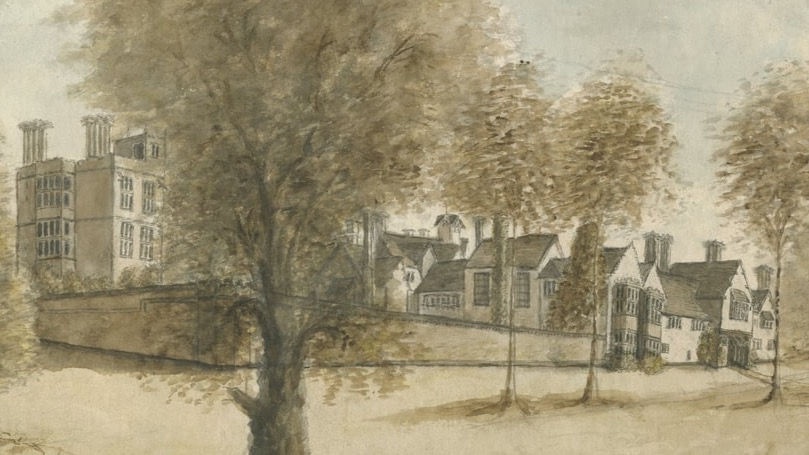
Since the early 1590s, after relinquishing her claims to other properties in favour of her son Robert Devereux, 2nd Earl of Essex, Lettice and her third husband Sir Christopher Blount, had taken up residence at the manor of Drayton Bassett, near Tamworth, Staffordshire, only twenty-five miles from her the Devereux seat of Chartley Manor. The lease of the property had been purchased by Lettice's second husband, Robert Dudley, 1st Earl of Leicester, in April 1579, and on his death in September 1588, had been bequeathed to his wife. Lettice remained banished from the Royal Court, and out of favour with Elizabeth I, despite ongoing attempted interventions of family and friends, with Drayton Bassett therefore becoming her primary residence. Whilst less grand than her former properties of Kenilworth, Leicester House or Wanstead House, Drayton Bassett remained a comfortable home for Lettice for more than four decades. It was here that she entertained and hosted multiple family members, including her daughter Penelope Devereux, to whom she remained close throughout her life, being a frequent visitor. Following the executions of her son and husband in 1601, Lettice appears to have 'retired' to Staffordshire, rarely making any journeys afield, including for weddings or funerals of close family members (Varlow, 2009; Tallis, 2017).
Lettice had written her will, twelve years before her death, on 15 October 1622, in which Lettice describes herself, then almost years old, in which she described herself as "being in perfect health and memorie" (The National Archives, 2025). Tallis (2017, p.329), notes that whilst in her 80s, Lettice was continuing to maintain regular correspondence, but regularly referred to her "shaky hand". In February 1632, a report commenting on the declining health of her younger brother William Knollys, 1st Earl of Banbury, reflected "The Earle of Banbury, now four-skore and six, is said to lye upon his death-bed; but I hear that his sister, my Lady of Leicester, being six years elder, can yet walke a mile in the morning" (Urban, 1846, p.256).

Lettice died on 25 December 1634; according to a plaque that was later erected near her tomb, it was "upon Christmas Day in the morning". Living to the grand age of 91, Lettice had outlived her parents, her three husbands and all her children. She had also outlived all of her fifteen siblings, apart from one: her younger brother, Sir Francis Knollys, named after their father, who like Lettice, lived into his 90s. However, she left behind her many children and grandchildren, including grandsons Robert Devereux, 3rd Earl of Essex, Robert Rich, 2nd Earl of Warwick, Henry Rich, 1st Earl of Holland and Algernon Percy, 10th Earl of Northumberland. Whilst unsubstantiated, there were later reports that she had multiple family members present at her side at the time of her death (Tallis, 2017).
In her 1622 will, Lettice requested that her body should be buried "without pomp at the discretion of my executors". However, she made more direct instructions in that she should be buried "at Warwick with my dear Lord and husband the Earle of Leicester", with whom she would be "intombed" (The National Archives, 2025).
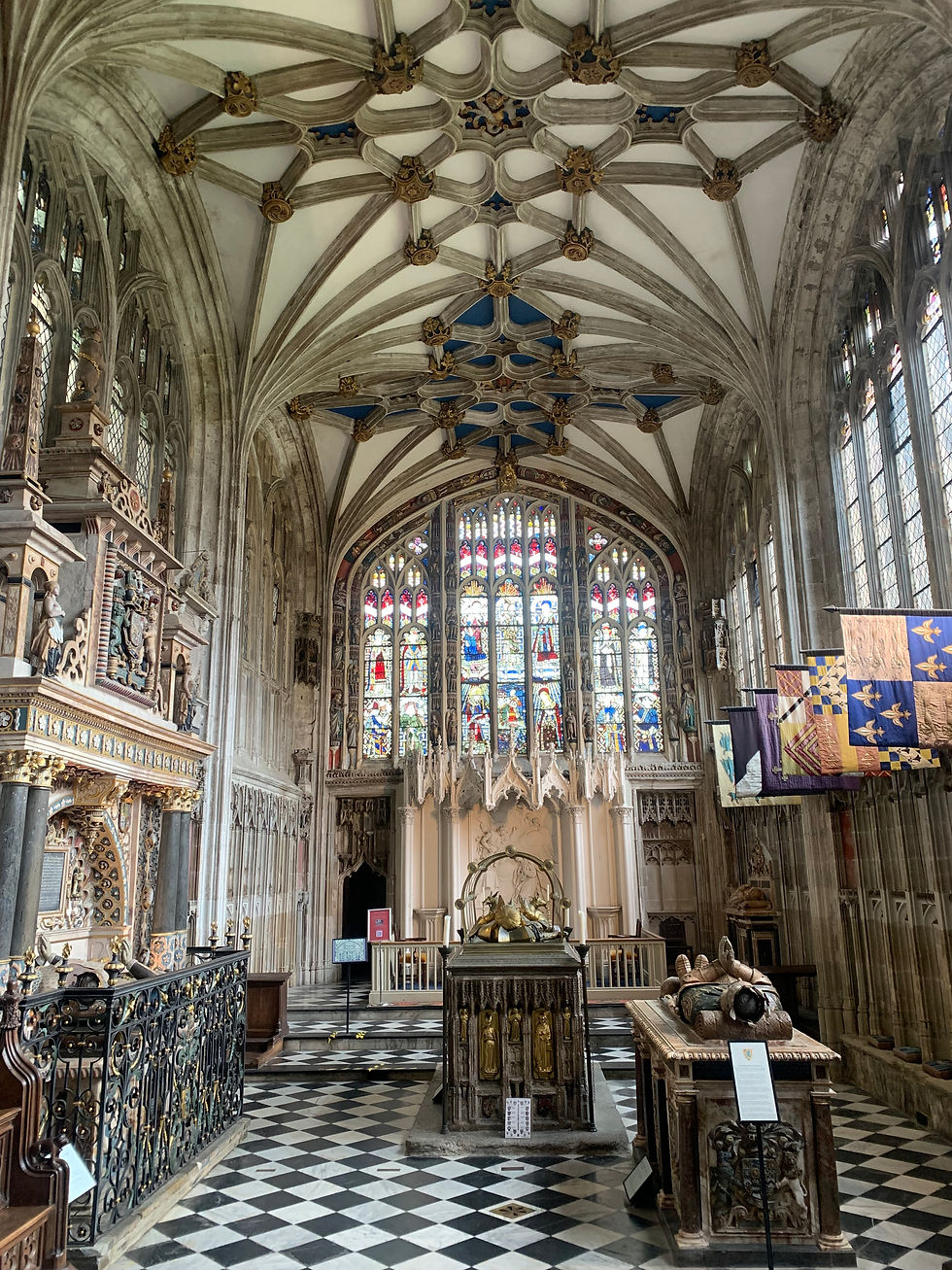
In February 1635, Lettice was subsequently interred in the Beauchamp Chapel (contemporarily known as the 'Lady Chapel' or the 'Chapel of Our Lady'), within the Collegiate Church of St Mary, in the market town of Warwick, five miles south of Kenilworth Castle, Warwickshire. The chapel was located on the south side of the church, adjourning the quire, and had been built to house the remains of the Dudley's ancestor, Richard Beauchamp, 13th Earl of Warwick, in the mid-15th century, whose "magnificent Tombe" was said to be "inferior to none in England, except that of K. H. 7. [King Henry VII] in Westminster Abbey" (Dugdale, 1656, p.354).

Following Leicester's death in September 1588, and subsequent funeral the following month, Lettice commissioned for an elaborated tomb to be erected on the east wall of the Chapel, in which she dedicated to "the best and dearest of husbands". The tomb, which was likely designed and constructed in the Midlands, prominently displayed the emblems adopted by Leicester (and his elder brother Ambrose, 3rd Earl of Warwick, who was interred in the chapel, directly opposite him, following his own death 18 months later): the bear and ragged staff. It was under this same monument where her second husband had been laid more than 46 years earlier, than Lettice's body was now placed alongside. Matching coloured tomb effigies of the couple lying side-by-side had been constructed in preparation; the couple depicted in their matching earl and countess coronets, in a state of eternal repose, symbolising their religious beliefs related to death, the afterlife and resurrection (Clark, 2023).
An epitaph dedicated to Lettice was written following her death, and has been attributed to 'Gervase Clifton'; it is unclear whether this is her great-grandson, the son of Lady Penelope Rich (the first of Lettice's daughter Penelope Devereux's illegitimate children with her long-time lover, Sir Charles Blount), or his father Sir Gervase Clifton, 1st Baronet, whom Lettice had identified as a beneficiary in her will, even after his wife death. The verses, printed on wooden boards close to the tomb of Lettice and Leicester, confirm her death on Christmas Day. Whilst a flattering and obviously bias picture of the late-Countess and her family are painted, Lettice's longstanding impact on Elizabethan society could not be ignored (Urban, 1846; Tallis, 2017).
![Epitaph of Lettice, Countess of Leicester, Beauchamp Chapel, St Mary's Church, Warwick © The Dudley Women [Mar 2024]](https://static.wixstatic.com/media/ed9b82_a0950faad02148e88b4fc72ad5cfd50c~mv2.png/v1/fill/w_980,h_890,al_c,q_90,usm_0.66_1.00_0.01,enc_avif,quality_auto/ed9b82_a0950faad02148e88b4fc72ad5cfd50c~mv2.png)
Upon the death of the excellent and pious Lady Lettice Countess of Leicester who died upon Christmas Day in the morning, 1634. Looke in this vault and search it well, Much treasure in it lately fell. Wee all are rob'd, and all doe say, Our wealth was carryed this away! And that the theft might nere be found, Tis buried closely under ground. Yet if you gently stirr the mould, There may you see that face, that hand, Which once was fairest in the land. She that in her younger yeares, Matcht with two great English peares, She that did supplye the warrs, With thunder and the court with stars. She that in her youth her bene, Darling to the Maiden Queene. Till she was content to quitt, Her Favoure for her Favouritt. Whose gould threed when she saw spun, And the death of her brave sonn. Thought it safest to retyre, From all care and vaine desire. To a private countrie cell, Where she spent her dayes so well. That to her the better sort, Came as to a holy court. And the poore that lived neare, Dearth nor famine could. not feare. Whilst she livd she lived thus, Till that God displeasd with us. Suffred her at last to fall, Not from him but from us all. And because she took delight, Christs poore members to invite. He fully now requites her love, And sends his angels from above. That did to Heaven her soul convay, To solemnize his own birth day. Gervase Clifton


![© amthomson [Flickr]](https://static.wixstatic.com/media/ed9b82_8aedc22207c84995a0c91428d527935b~mv2.jpg/v1/fill/w_980,h_735,al_c,q_85,usm_0.66_1.00_0.01,enc_avif,quality_auto/ed9b82_8aedc22207c84995a0c91428d527935b~mv2.jpg)
Comments