
The Death of John Talbot, 1st Earl of Shrewsbury: "The Scourge of France" - 17 July 1453
thedudleywomen
Jul 17
12 min read

Edmund Dudley, an ambitious lawyer whose work within London's Courts of Justice in the late 15th century, had led employment by Sir Reginald Bray, Henry VII's chief financial administrator, and his subsequent appointment within the king's Privy Council. Reflective of his growing-social status, further demonstrated by his appointment as Speaker of the House of Commons in January 1504, widower Dudley had remarried; his bride was Elizabeth Grey, the daughter of Edward Grey, 1st Viscount Lisle and his wife Elizabeth Talbot, daughter and heir of John Talbot, 1st Viscount Lisle (Penn, 2011; Paul, 2022). Collins (1746) suggests that Dudley had been granted Elizabeth's wardship in 1494 ('10 Henry VII'), a young woman descended from great noble families and of a higher social status, as a reward for his role in negotiating an important peace treaty, the Peace of Étaples, with France in 1492.
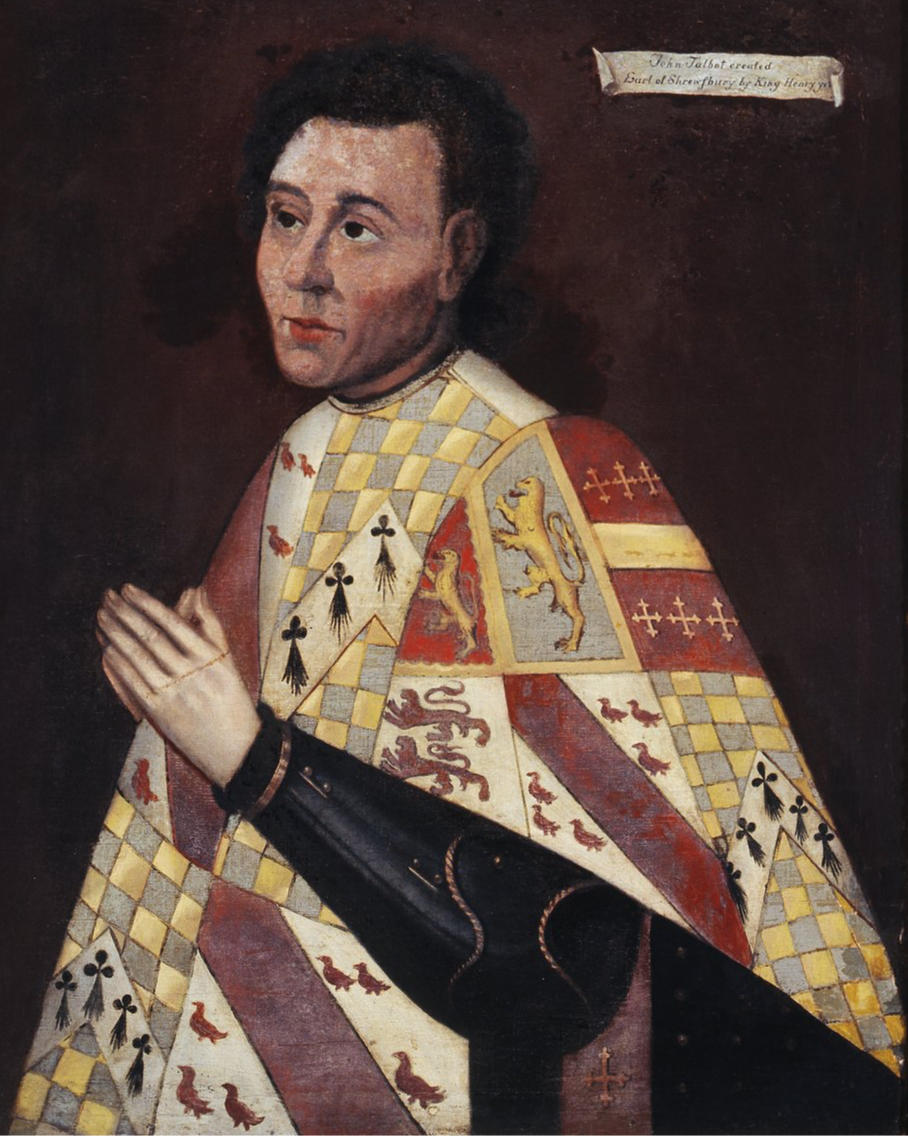
John Talbot, 1st Viscount Lisle was the eldest son of John Talbot, 1st Earl of Shrewsbury from his second marriage to Margaret Beauchamp, the daughter of Richard Beauchamp, 13th Earl of Warwick. Through his mother, John Talbot inherited the Barony of Lisle in 1444, and was later created Viscount Lisle in 1451. With his wife, Joan Cheddar, whom he had married in 1443, Lisle had children, including son Thomas, and daughters Elizabeth and Margaret. Whilst Thomas initially inherited the title of Viscount Lisle on their father's death, the titles passed through Elizabeth's family as her brother died without heirs; Elizabeth's husband, Edward Grey was later created 1st Viscount Lisle in recognition of her noble ancestry, as would their daughter, Elizabeth Grey's second husband in 1523. It was only with the death of Arthur Plantagenet in 1542 that the title would return to a direct descendant of John Talbot, with Elizabeth Grey's eldest son Sir John Dudley being successful in his claim to ascend to this noble rank (Lee, 1898; Talbot, 1981; Paul, 2022).
The elder John Talbot, already having proved his military abilities against the Welsh and in Ireland, had been called to France by Henry V in 1419, in the ongoing 'Hundred Years' War': an 116-year-long conflict between England and the French, initially triggered by English king Edward III's claim as King of France. As a result of his military service and leadership, he was subsequently rewarded with the appointment to the Order of the Garter in 1434, and later the Earldom of Shrewsbury in 1442. In 1445, Shrewsbury was appointed by Henry VI as Constable as France, and continued to act as one of the king's trusted military leaders throughout the conflict, despite being held hostage by the French king for almost nine months in 1449 (Lee, 1898; Jones, 2014).

On 17 July 1453, the 'Battle of Castillon' took place: a battle between the French and English forces, near the town of Castillon-sur-Dordogne, Gascony, twenty-six miles east of the city of Bordeaux. The English, who were commanded by Shrewsbury, had been mistakenly informed that the French army were retreating from the town, and so gave pursuit. However, the French, using new artillery equipment, gave fire, killing thousands of English soldiers in the process, as well as their commander, who was famously known as the 'English Achilles' was killed during this skirmish. In the chaos of battle, Shrewsbury was shot in the leg, causing him to dismount from his horse; it was then that he was 'cut-down' by a battle-axe, reportedly by French soldiers who did not recognise him. His son, Viscount Lisle, reportedly came to his father's side, refusing to leave him, which led to his own death. Shrewsbury's dead body was then reportedly trampled, leaving it unrecognisable to most, but identified by his herald (Lee, 1898; Weir, 1995; Jones, 2014).
After Shrewsbury's death, he was reportedly initially interred under a mound close to the battle ground, with a chapel erected on it known as 'la chappelle de Talbot'. Fifty years later, his grandson, Sir Gilbert Talbot of Grafton, arranged for his remains to be brought back to England. They were subsequently interred in a tomb at St Alkmund's Church, Whitchurch, with his embalmed heart buried separately in a silver urn, under the church's porch. When renovation work took place in the church in 1874, the bones were examined and photographed; a large hole was observed at the back of the skull, supporting the contemporary reports of the manner of his death. His son, Viscount Lisle's body was never identified, and so lies buried amongst the thousands of Englishmen he died alongside on the battlefield at Castillon (Lee, 1898; Talbot, 1981; Whitchurch Heritage Centre, 2025).

The consequences of Shrewbury's death were catastrophic to England's centuries-long campaign in France; only three months of the death of one of their highest-ranking leaders, the English surrendered their long-held control of Bordeaux and Aquitaine to the French, and subsequently withdrew from the country, 'The Hundred Years War' finally coming to an end. More significantly however, was the impact of these events on the English monarch: only weeks after Shrewsbury's death, 31-year-old Henry VI experienced his first significant episode of mental illness (Jones, 2014).
Henry has been travelling away from court during the summer; on the evening of 18 August 1453, whilst at his hunting lodge at Claredon, near Salisbury, Wiltshire, he reportedly complained of feeling unusually sleepy, but retired to bed as expected. By the following morning, he had fallen into a stupor, being unable to communicate with anyone, or move independently, including being unable to hold up his head. This description of an acute onset of symptoms, and the prolonged length of the episode, appears in keeping with catatonia. This state is predominantly seen in people suffering from severe and enduring mental illnesses, with those affected felt to be at an increased risk of initially developing or relapsing with their psychiatric symptoms, in response to psychological risk factors, including stress (Weir, 1995; Jones, 2014; Royal College of Psychiatrists, 2024).

It has been hypothesised by modern medical historians that Henry likely suffered from a recurrent psychotic illness, likely schizophrenia, given his repeated episodes of erratic and unusual behaviour (including another prolonged catatonic episode). This was in addition to strong familial history: his maternal grandfather, Charles VI of France suffered from multiple episodes of mental illness during his reign, displaying apparent manic and psychotic symptoms at times, including a belief that he was made from glass, culminating in him killing four people with his lance, before being overpowered by his attendants. People who suffer from schizophrenia, a severe and enduring mental illness, can experience affective (mood disturbances) and 'positive' psychotic symptoms, including hallucinations (perceptional disturbances impacting the senses) and delusional beliefs (fixed, false beliefs), which may lead them to act unpredictability and erractically, due to an inability to engage appropriately with others and the environment around them. However, others suffering from untreated psychosis, can experience catatonia, which is characterised by some of the following symptoms:
sitting still, with minimal movements or becoming significantly agitated/restless
holding themselves in unusual postures
engaging in repetitive movements ('stereotypy')
repeating the same movements observed from others ('echopraxia')
repeating the same words and phrases observed from others ('echolalia')
none or minimal speaking, eating or drinking
(Weir, 1995; Royal College of Psychiatrists, 2024).

The king's unexpected incapacitation, described contemporaneously as him taking a "sudden and thoughtless fright", sent shockwaves through Henry's council. His condition was kept secret for the first few weeks, with multiple physicians attending to him and providing various treatments in the attempt to rouse him out of his stupor; these included his chief physician, John Arundel, who in addition to his royal duties, was employed as the warden of St Mary Bethlehem Hospital, the famous asylum 'Bedlam'. Despite the expertises and experience of Arundel and his peers, Henry's catatonic state continued, with the king "appearing uncurious and unconscious" to events around him, not even responding to news of the birth of his son and heir Prince Edward in October 1453. As time passed, it became clear that a strong and competent ruler was required to lead the country, and to quell the brewing civil unrest. Two candidates put themselves forward for the job: the king's cousins, John Beaufort, 2nd Duke of Somerset, representing the House of Lancaster, and Richard Plantagenet, 3rd Duke of York, representing the House of York, with the latter successfully emerging Protector of the Realm in March 1454. Henry's stupor continued until Christmas Day 1454, when the king suddenly recovered, having no knowledge or memory of the previous 16 months. York was subsequently removed from his position, his limited tenure as Protector unfortunately not having the impact on national policies that he planned, but causing further division between the two factions of Lancaster and York. The Duke's ongoing disillusionment with the 'weak' Henry, in additional to his ongoing pursuit of power, led to a thirty-year civil war, known as 'The Cousin's War' or 'The Wars of the Roses', the first conflict, 'The First Battle of St Albans' taking place less than six months later (Weir, 1995; Jones, 2014).
Shrewsbury's and Lisle's deaths are famously depicted in Henry VI, Part 1; a late-16th century history play attributed to William Shakespeare, although felt by many historians to be either a collaboration, or a rewrite of an earlier draft initially penned by other playwrights. Described as an "uncompromising celebration of early English nationalism and imperialism", Henry VI, Part 1 is a dramatic retelling of the early years of the reign of Henry VI, who succeeded to the English throne in 1522 when only eight months old, following the premature death of his father, Henry V. The play recounts the issues related to the king's succession and protectorship, making reference to the origins in the division of the noble houses of Lancaster and York'. It also depicts the concluding years of 'The Hundred Years War', including Shrewsbury's time in captivity, as well as highly-dramatised version of 'Joan la Pucelle', more commonly known as 'Joan of Arc' (Folger Shakespeare Library [1], 2025; RSC, 2025; Shakespeare Birthplace Trust, 2025).

In Henry VI, Part 1, the elder Shrewsbury is referred to as simply "Talbot", whilst his son Lisle is referred to as "John Talbot". Talbot is portrayed as a reliable "masculine warrior hero", despite the challenges he faces, including his imprisonment. His maturity, nobility and stoicism is the contrast to the younger, impulsive peasant Joan: an intentional story-telling technique, with the English protagonist standing firm against the French enemy (Folger Shakespeare Library [1], 2025; Shakespeare Birthplace Trust, 2025)
Talbot's reputation with his contempotaries proceeded him, and was revived 140 years after his death with his dramatic portrayal; in Act 2 Scene 3, the French Countess of Auvergne intentionally mocks his appearance, given his heroic reputation (Folger Shakespeare Library [2], 2025):
Is this the scourge of France? Is this the Talbot, so much feared abroad... I see report is fabulous and false.
Ultimately, Talbot and his son's sacrificial deaths are viewed as senseless, as surviving Englishmen, such as Somerset and Bedford continue to act in their own self-interests and "preying on each other in the service of their own ambitions" (Folger Shakespeare Library [1], 2025).

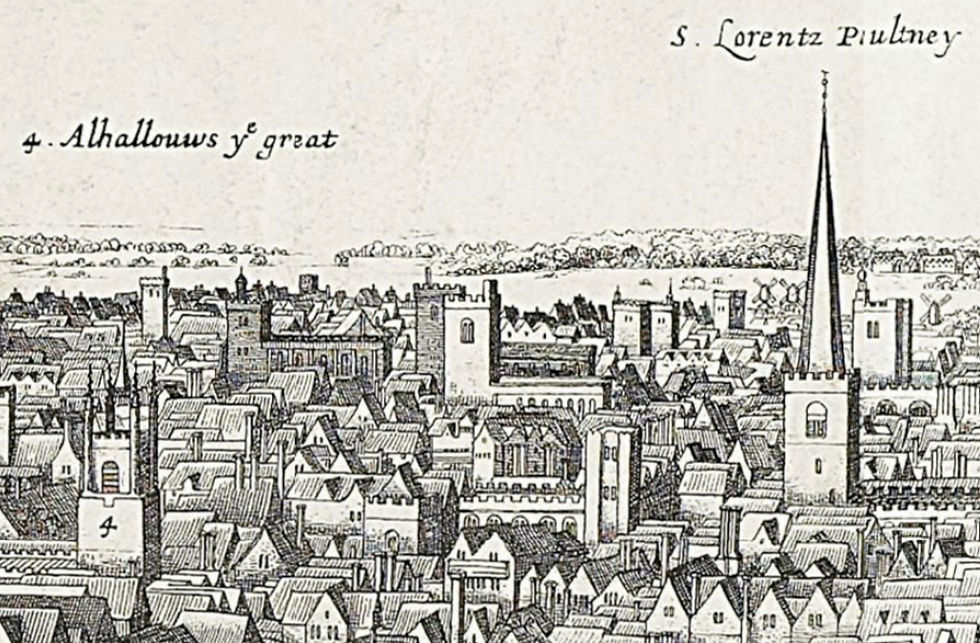
Theatrical entrepreneur Philip Henslowe kept meticulous records of his financial transactions, which survives today in a document known as Henslowe's Diary. Henslowe recorded that the first performance of Henry VI, Part 1 (written as harey the vj) was first performed on 03 March 1592 at The Rose Theatre: a fourteen-sided 'play house' he had built five years earlier and had recently expanded, at Southwark, located near the bear-baiting and bull-baiting pits, close to the south bank of the River Thames. The performing company, Lord Strange's Men, named for their patron Ferninando Stanley, Lord Strange, performed at The Rose from February 1592, and were led by Edward Alleyn, contemporarily described as "one of England's greatest actors". Known for his portrayal of powerful and commanding characters, "who roars his part as he crosses the stage", Alleyn was said to have been the first to perform the role of the heroic 'Talbot' in the first performances of Henry VI, Part 1 at The Rose. These reports appear in contrast with the on-stage interaction between Talbot and his captor, the French Countess of Auvergne, in Act 2 Scene 3, in which she openly mocks his appearance, stating that she expected a "Hercules" or a "Hector" rather than a "child...a silly dwarf", with Talbot himself acknowledging "I am but shadow of myself". Henry V, Part I was one of multiple plays performed at The Rose during this period, all of which were suspended from June 1592 for almost two years, due to the spread of bubonic plague throughout the city (Stephen and Lee, 1917; Mortimer, 2011; Folger Shakespeare Library [2],. 2025; RSC, 2025).
![Detail from 'Norden's Map of London', depicting 'The play house' [The Rose]. Engraved by Pieter van den Keere © Yale University Library](https://static.wixstatic.com/media/ed9b82_803c68688f46467da79b77989e1d1c36~mv2.png/v1/fill/w_980,h_480,al_c,q_90,usm_0.66_1.00_0.01,enc_avif,quality_auto/ed9b82_803c68688f46467da79b77989e1d1c36~mv2.png)
The performance of Henry VI, Part 1 at The Rose was referenced in a 1592 pamphlet Pierce Penniless, his Supplication to the Devil: a satirical critique of social and political, written by poet and playwright Thomas Nashe. Whilst many complaints were laid out in the popular pamphlet, the author gives his support of theatrical performances, in particular those that involve the retelling of brave and victorious historical events. In the section 'The defence of plays', Nashe argues that in contrast to other vices associated with the sin of sloth, a theatrical performance held high moral standards (Oxford Authorship Site, 2025);
To this effect, the policy of plays is very necessary, howsoever some shallow-brained censurers...mightily oppugn them. For whereas the afternoon being the idlest time of the day, wherein men that are their own masters (as gentlemen of the court, the Inns of Court, and the number of captains and soldiers about London) do wholly bestow themselves upon pleasure, and that pleasure they divide...either into gaming, following of harlots, drinking, or seeing a play, is it not then better...that they should betake them to the least, which is plays? Nay, what if I prove plays to be no extreme, but a rare exercise of virtue? First, for the subject of them (for the most part) it is borrowed out of our English chronicles, wherein our forefathers' valiant acts (that have lien long buried in rusty brass and worm-eaten books) are revived, and they themselves raised from the grave of oblivion, and brought to plead their aged honours in open presence...
Nashe then makes specific reference to Henry VI, Part 1, in particular the dramatic death scene of Talbot (Oxford Authorship Site, 2025):
How would it have joyed brave Talbot (the terror of the French) to think that after he had lien two hundred years in his tomb, he should triumph again on the stage, and have his bones new embalmed with the tears of ten thousand spectators at least (at several times), who, in the tragedian that represents his person, imagine they behold him fresh bleeding.


Comments