
Traitors in the Tower Liberties: Executions at Tower Hill and the Tower of London
thedudleywomen
Jan 3
10 min read
Updated: Mar 1
In medieval and early-modern London, there were multiple public places of execution, places where death sentences which had been given to prisoners convicted of serious crimes against the monarch or the state, including treason and heresy, were carried out. These locations included Tyburn (the location of the city's primary public gallows), Smithfield marketplace and the churchyard of St-Giles-in-the-Field. In 1464, another site was established on a raised plot of land, overlooking the Tower of London: Tower Hill (Besant, 1903; Map of Early Modern London, 2025).

The Tower of London was intentionally located outside the boundaries of the City of London, to the east of the city; in medieval England, London's total area was only one square mile, the city being packed with houses, churches and marketplaces, all surrounded by the historic (and recently restored) city wall. As Thurley (2019) writes, in the Tower's inception and initial construction following the Norman Conquest in the later half of the 11th century, its intention was to oppress and intimidate the newly conquered population. Whilst the Tower's initially built as a fortress, sitting on the banks of the River Thames, over the centuries with expansion, its function evolved, becoming amongst other things, a prison and site of execution. Located within the 'Liberties of the Tower of London', the administrative and judicial control of the Tower subsequently lay outside the control of the City of London, and instead with the Crown. As the most senior official, power and authority lay day-to-day with the Constable of the Tower, independent from the city sitting just to its west, although relinquished that power if the monarch was in residence. It also maintained financial independence, collecting rents from house and tenaments within the Liberty, as well as issuing tolls on boats and ships passing by, on their way into the city (British History Online, 2025; Early Modern Map of London, 2025; Historic Royal Palaces [1], 2025).

The site chosen for the location of a new permanent scaffold was upon Tower Hill: a large area of open land, that stood to the north-west, overlooking the medieval fortress, but within the Tower Liberties, and therefore the jurisdiction of Tower officials. Executions, including burnings and beheadings, had taken place on the hill sporadically since the 14th century, including the executions of multiple high-profile Lancastrian noblemen in 1462, during the longstanding conflict, the Wars of the Roses. The location was chosen for a number of reasons, including its close proximity to the Tower, where many of the high-profile condemned prisoners were being held prior to their deaths. As the Norman William I had intended, the Tower's dominance over the local landscape remained, continuing to instil a degree of fear to its residents and vistors. The decision to conduct executions in front of this significantly-oppressive backdrop became a warning to many. Tower Hill also being a large open area, with easy access by either foot or water, meant that public executions there would be a spectacle; it has been estimated that up to 50,000 people watched as John Dudley, 1st Duke of Northumberland was beheaded on the scaffold on 22 August 1553 (Porter, 2012; Paul, 2022; Early Modern Map of London, 2025).
During the reign of the Tudor monarchs, from Henry VII's accession in 1485, to the death of Elizabeth I in 1603, the Tower of London was used as a prison for high-profile prisoners, accused and charged with serious crimes, including treason and heresy. For those convicted of these offences, either following a trial or by an Act of Attainder passed through Parliament, the sentence of death would be passed upon them. Whilst there were some prisoners whose death sentence was not carried out, and were subsequently released from the Tower and pardoned, including Dudley brothers John, Ambrose, Robert and Harry in October 1554, there were many others who lost their lives within the Tower Liberties. Most were taken from the Tower, and marched over to the permanent scaffold, for their final act of public humiliation. However, there were some who were given the 'privilege' of having their sentences carried out within the walls of the Tower. Whilst crowds would still gather, entrance could be controlled, monitored and limited by Tower officials, beneficial for those prisoners of high-status (including two of Henry VIII's queens), or those perceived as having "dangerously strong public support" (Paul, 2022; Historic Royal Palaces [2], 2025).

Whilst contemporary accounts from witnesses of these executions still exist, there were at times attempts to censor them; this may have arisen if spectators were critical of the sentence or the manner of execution, or if by publishing information would increase support for the executed prisoner and their cause. Following the execution of Sir Thomas More, Henry VIII's former Lord Chancellor, in 1534, the king banned any publication of reports describing his execution, given the support he had gathered from Catholics, also disputing religious reform (Borman, 2018). Some of the most high-profile and infamous prisoners who lost their lives on Tower Hill or within the Tower, had close familial ties or members of the Dudley family. Thomas Audley, 1st Baron Audley, and father of Margaret Audley, as Henry VIII's Lord Chancellor, was involved in and oversaw many trials of high-status and high-profile prisoners accused of treason, as well as ensuring Acts of Attainder were passed through Parliament, until his death in 1544 (Borman 2018; Paul, 2022);
Date of Execution | Executed Prisoner | Place of Execution | Place of Burial | |
17 August 1510 | Tower Hill (Beheading) | Blackfriars Priory, London | ||
22 June 1535 | John Fisher, Bishop of Rochester | Tower Hill (Beheading) | All Hallows Barking Church; later interred at Chapel of St Peter ad Vincula, Tower of London | |
06 July 1535 | Sir Thomas More | Tower Hill (Beheading) | Chapel of St Peter ad Vincula, Tower of London. Head buried with at Chelsea; later reinterred at Canterbury | |
17 May 1536 | George Boleyn, Viscount Rochford | Tower Hill (Beheading) | Chapel of St Peter ad Vincula, Tower of London | |
19 May 1536 | Tower of London (Beheading) | Chapel of St Peter ad Vincula, Tower of London | ||
28 July 1540 | Thomas Cromwell, 1st Earl of Essex | Tower Hill (Beheading) | Chapel of St Peter ad Vincula, Tower of London | |
27 May 1541 | Margaret Plantagenet, Countess of Salisbury | Tower of London (Beheading) | Chapel of St Peter ad Vincula, Tower of London | |
13 February 1542 | Tower of London (Beheading) | Chapel of St Peter ad Vincula, Tower of London | ||
13 Februrary 1542 | Tower of London (Beheading) | Chapel of St Peter ad Vincula, Tower of London | ||
19 January 1547 | Henry Howard, Earl of Surrey | Tower Hill (Beheading) | All Hallows Barking; later reinterred at St Michael's Church, Framlingham | |
20 March 1549 | Tower Hill (Beheading) | Chapel of St Peter ad Vincula, Tower of London | ||
22 January 1552 | Edward Seymour, 1st Duke of Somerset | Tower Hill (Beheading) | Chapel of St Peter ad Vincula, Tower of London | |
22 August 1553 | John Dudley, 1st Duke of Northumberland | Tower Hill (Beheading) | Chapel of St Peter ad Vincula, Tower of London | |
12 February 1554 | Guildford Dudley | Tower Hill (Beheading) | Chapel of St Peter ad Vincula, Tower of London | |
12 February 1554 | Jane Grey, Lady Dudley | Tower of London (Beheading) | Chapel of St Peter ad Vincula, Tower of London | |
21 February 1554 | Henry Grey, 1st Duke of Suffolk | Tower Hill (Beheading) | Body buried in Chapel of St Peter ad Vincula, Tower of London Head likely found in vault at Church of Holy Trinity, Minories | |
27 April 1554 | Lord Thomas Grey | Tower Hill (Beheading) | All Hallows Barking Church, London | |
02 June 1572 | Tower Hill (Beheading) | Chapel of St Peter ad Vincula, Tower of London | ||
25 February 1601 | Tower of London (Beheading) | Chapel of St Peter ad Vincula, Tower of London | ||
18 March 1601 | Tower Hill (Beheading) | Chapel of St Peter ad Vincula, Tower of London | ||

In 1598, historian and antiquarian John Stow published his work 'A Survay of London': a detailed topographical and historical guide of the city. In his work, Stow makes reference to the scaffold on Tower Hill: "Upon this Hil is alwayes readily prepared, at the charges of the Citie, a large scaffold, and gallows of timber, for the execution of such traitors or other transgressors as are delivered out of the Tower, or otherwise to the sheriffes of London, by writ, there were to be executed" (Besant, 1903, p.286).
There had been ongoing conflicts between the Crown and the City of London regarding the boundaries of the Tower Liberties, since its establishment in the 13th century. By the end of the 16th century, the City of London claimed that Tower Hill fell under their juristicition, alleging that the boundary markers had been moved. In 1579, the Privy Council conducted an official inquiry regarding ongoing disputes between the 'Gentleman Porter of the Tower' and the city's Lord Mayor, with accusations that the 'boundary stones' had been moved. In June 1595, the Lord Mayor accompanied by armed officers, attended the location in response to ‘unrulie youthes on the towerhill': a large gathering of apprentices protesting social issues directly impacting them - rising food costs, inadequate living conditions and social inequality. Subsequently there were those questioning whether the Lord Mayor had thereby overstepped his authority, including Tower officials, although it was acknowledged that this intervention helped quickly quell the 1000-men riot (Keay, 2001; Porter, 2012).

In June 1597, acknowledging ongoing animosity between the Lord Mayor and the Tower's senior officers, a survey of the Tower and its surrounding area was undertaken, commissioned by the Tower's newly-appointed Lieutenant, Sir John Peyton. Employing experienced surveyors William Haiward and John Gasgoyne, plans were drawn up depicting the boundaries of the Tower Liberties, which Keay (2001, p.9) describes as being "more controversial and explosive than ever". On copies of their survey, Haiward and Gasgoyne made reference to the "Leet, Anno 27, Hen. 8" - this was the proclamation issued in 1536, during the reign of Henry VIII, which confirmed the boundaries of the Tower Liberties, initially set out during the reign of Richard II in the 14th century. The 1597 surveyors list the established boundary markers on their plan, with the area within them marked out: the Tower of London and Tower Hill (including the location of 'the Posts of the Scaffold)' are shown clearly falling outside the boundaries of the city, and within the Tower Liberties (Keay, 2001; Porter, 2012).
The execution of Scottish clan leader Simon Fraser, 11th Lord Lovat on 09 April 1747 was the final time the scaffold at Tower Hill was used for a public execution of a member of the nobility. Lovat had been convicted of high treason for his role in the 1745 Jacobite uprising, an attempt by the exiled James II's son 'Bonnie Prince Charlie' to regain the British throne on behalf of his Catholic father. Lovat would be the last man beheaded, both on the Tower Hill scaffold, and in England. After 1750, the majority of public executions were moved to the gallows at Tyburn. Temporary gallows erected at Tower Hill were continuing to be used sporadically until 1780, where the final executions took place: the hanging of three people convicted of treason, including the only known two women who died on Tower Hill (Historic Royal Palaces [3], 2025).

On what is believed to have been the site of the permanent scaffold, located in what is now Trinity Square Gardens, a small memorial was erected at the end of the 19th century "to commemorate the tragic history and in many cases the martyrdom of of those who for the sake of their faith country or ideals staked their lives and lost". The focal point of the memorial is a stone tablet (which has since been overlaid with brass), which reads "Site of Ancient Scaffold, Here the Earl of Kilmarnock and Lord Balmerino Suffered, 18 August 1746". Plaques later erected around the memorial list 29 men of the estimated 125 people who lost their lives on this site (Historical Royal Palaces [3], 2025; Royal Collection Trust, 2025).
📷 Aug 2025 © The Dudley Women 📷 Aug 2025 © The Dudley Women 📷 Aug 2025 © The Dudley Women
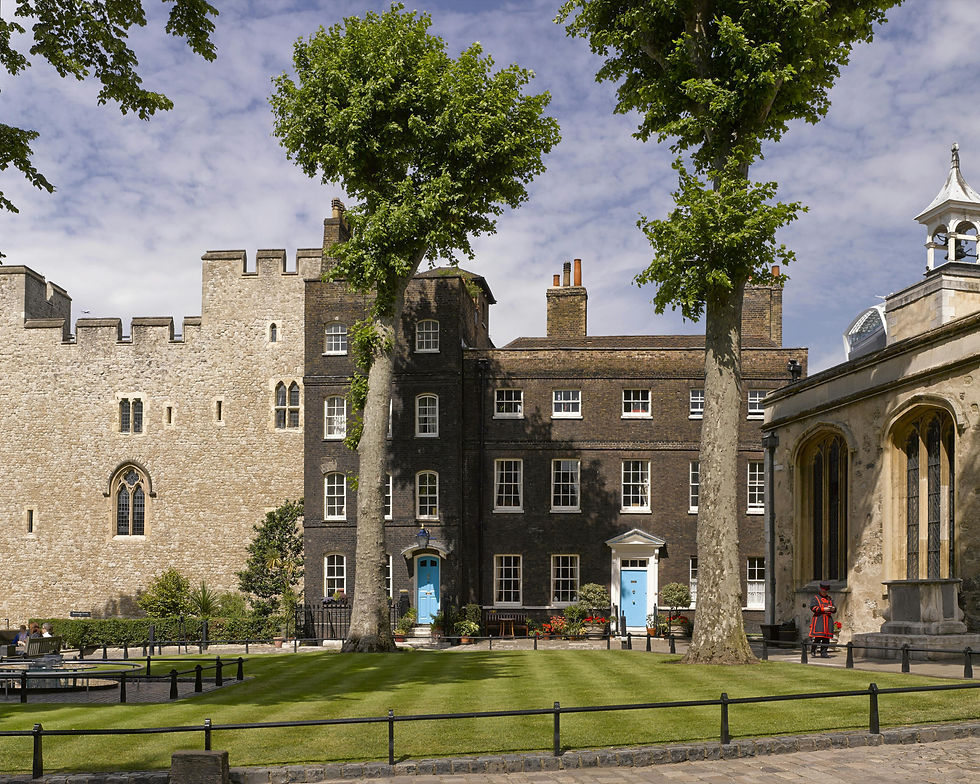
In 1876, restoration work was carried out in the Tower's chapel of St Peter ad Vincula, where many high-profile executed prisoners from both the Tower and Tower Hill were interred. After memorial stones were placed on the altar floor of the chapel, it was also decided that a memorial should be erected to commemorate the ten people executed on Tower Green. Queen Victoria had paving laid, similar to that on Tower Hill, on what was believed to be the location of one of the scaffold sites, there being no permament fixture erected within the Tower, with an additional glass memorial erected in 2006 (Porter, 2012; Historic Royal Palaces [2], 2025).


Comments